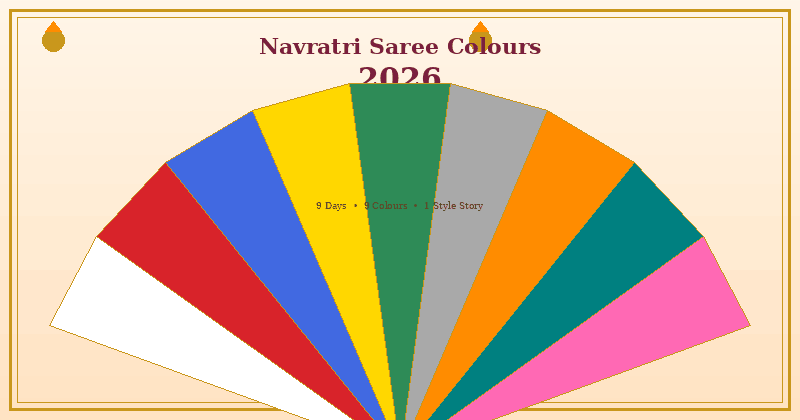
If you’ve typed “today’s colour of Navratri” into Google at 7 AM while standing in front of your closet, you’re not alone. Every year, right before Navratri, this becomes one of the most searched festival questions in India — and for good reason. Getting the colour right isn’t just about looking coordinated at the pandal or the garba floor. Each shade is tied to a specific form of Maa Durga, and wearing it is a small, personal way of joining in the day’s energy.
This year, Shardiya Navratri (the big one, celebrated across North and East India) falls from October 11 to October 19, 2026, with Ghatasthapana on Sunday, October 11, and Dussehra on Tuesday, October 20. Below is the complete day-by-day colour list for 2026, plus a few notes on how to actually wear these colours without turning your wardrobe upside down.
Navratri 2026 Full Colour Chart
| Day | Date (2026) | Colour | Goddess |
|---|---|---|---|
| Day 1 | Sunday, Oct 11 | Orange | Maa Shailputri |
| Day 2 | Monday, Oct 12 | White | Maa Brahmacharini |
| Day 3 | Tuesday, Oct 13 | Red | Maa Chandraghanta |
| Day 4 | Wednesday, Oct 14 | Royal Blue | Maa Kushmanda |
| Day 5 | Thursday, Oct 15 | Yellow | Maa Skandamata |
| Day 6 | Friday, Oct 16 | Green | Maa Katyayani |
| Day 7 | Saturday, Oct 17 | Grey | Maa Kalaratri |
| Day 8 | Sunday, Oct 18 | Purple | Maa Mahagauri |
| Day 9 | Monday, Oct 19 | Peacock Green | Maa Siddhidatri |
Bookmark this table — it’s the one you’ll want to check back on through the nine days instead of re-Googling “colour for Navratri” every single morning.
Day-by-Day Breakdown: What Each Colour Means and What to Wear
Day 1 (Oct 11) — Orange: Maa Shailputri
Navratri opens with orange, and it’s a fitting start. Orange is warmth, energy, and the little jolt of enthusiasm that carries you through nine days of fasting, pujas, and late-night garba. A saffron or rust silk saree with a simple gold blouse works beautifully for the morning Ghatasthapana puja; save the heavily embellished orange lehenga for the evening dandiya.
Day 2 (Oct 12) — White: Maa Brahmacharini
White stands for peace and simplicity — think chikankari, organza, or a plain cotton saree with silver jewellery rather than gold. It’s also the easiest colour to dress up later in the evening with a bold blouse or dupatta if white alone feels too subdued for a garba night.
Day 3 (Oct 13) — Red: Maa Chandraghanta
Red is strength and courage, and it’s usually the day people go all-in on traditional bridal-adjacent pieces — Banarasi or Kanjivaram sarees, heavy gold jewellery, a classic red bindi. If you only own one “festive red,” this is the day to bring it out.
Day 4 (Oct 14) — Royal Blue: Maa Kushmanda
Royal blue reads as rich and composed rather than loud, which makes it a favourite for office-goers who need to transition straight from work to the pandal. An indigo or cobalt saree with diamond or oxidised silver earrings hits the mark without trying too hard.
Day 5 (Oct 15) — Yellow: Maa Skandamata
Yellow is pure cheer. Mustard, sunflower, or a bright gold-tissue saree all work, and this is a colour that photographs exceptionally well for the daytime pandal-hopping crowd.
Day 6 (Oct 16) — Green: Maa Katyayani
Green signals growth and renewal. A lime or emerald saree with statement jhumkas is the easy, crowd-pleasing choice, and green is forgiving across skin tones, which is why it tends to sell out fastest in festive collections.
Day 7 (Oct 17) — Grey: Maa Kalaratri
Grey often gets skipped over because people assume it’s “boring,” but a good silver-grey silk with subtle embroidery looks unexpectedly elegant against all the brighter colours around it. Pair with oxidised jewellery to keep the grounded, balanced mood the colour is meant to represent.
Day 8 (Oct 18) — Purple: Maa Mahagauri
Purple lands on Durga Ashtami this year, which for many families is the most significant day of the nine — Kanya Pujan happens on the morning of Ashtami. A violet Paithani or Banarasi saree feels appropriately elevated for the occasion.
Day 9 (Oct 19) — Peacock Green: Maa Siddhidatri
The festival closes on Maha Navami with peacock green — a jewel tone that’s become one of the most requested festive shades in recent years. It’s a strong finish before Dussehra the next day.
How Are Navratri Colours Decided, Anyway?
There’s often confusion here, so it’s worth clearing up: the nine Navratri colours don’t shift with astrology or the day of the week in the way some articles suggest. The sequence — orange, white, red, royal blue, yellow, green, grey, purple, peacock green — is a fixed, traditional order tied to the nine forms of Durga (the Navadurga), and it repeats every year regardless of which weekday Navratri happens to start on. If you’ve seen slightly different colour lists floating around online, it’s usually because a source is describing Chaitra Navratri (the spring one, in March/April) rather than Shardiya Navratri (the autumn one most of India celebrates in a bigger way), or because regional customs vary slightly. The chart above is for Shardiya Navratri 2026.
Quick Tips for Planning Your Navratri Wardrobe
- Shop by fabric, not just colour. A silk saree in the day’s colour works for both morning puja and evening garba if you swap the blouse and jewellery.
- Keep two “wildcard” outfits ready — usually white and grey are the ones people forget to plan for, and they end up scrambling on the day.
- Jewellery does half the work. Gold for warm colours (orange, red, yellow), silver or oxidised for cooler ones (white, blue, grey, purple) is a simple rule that rarely fails.
- For garba and dandiya nights, prioritise comfort and movement over intricate detailing — you’ll be on your feet for hours.
Frequently Asked Questions
What is the colour for Navratri today?
Match today’s date against the table above — the colour changes daily through the nine days of the festival, from October 11 to October 19, 2026.
Is the Navratri colour the same every year?
The nine colours themselves (orange, white, red, royal blue, yellow, green, grey, purple, peacock green) stay the same each year in that fixed order. What changes yearly is which colour lands on which date, since Navratri’s dates shift based on the lunar calendar.
What colour is Navratri Day 1 in 2026?
Orange, dedicated to Maa Shailputri.
When is Navratri 2026?
Shardiya Navratri 2026 runs from Sunday, October 11 to Monday, October 19, with Dussehra on Tuesday, October 20.
Keep this page handy through the nine days — save it, screenshot the table, or just come back each morning to check today’s colour before you pick your outfit.