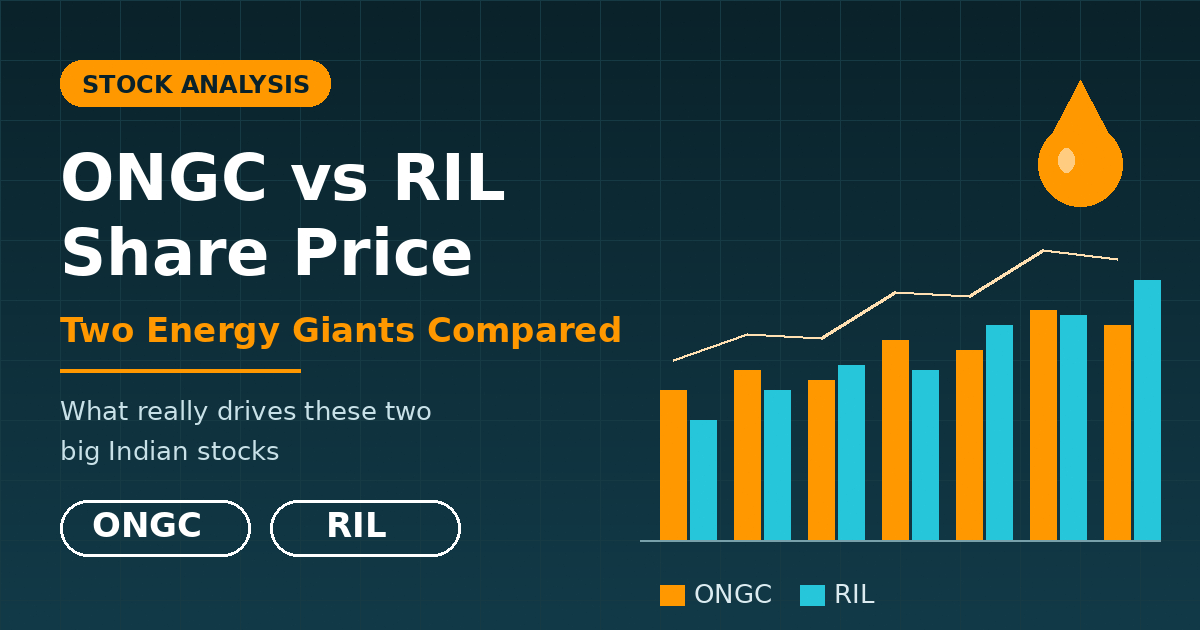
Mention “energy stocks” to an Indian investor and two names come up almost immediately: ONGC and Reliance. Both are huge, both are household names, and both show up in nearly every large portfolio. But if you put them side by side, they have very little in common beyond the word “oil” in their history.
Understanding that difference is the whole point. Looking at a price chart alone won’t tell you why one stock sits still for months while the other jumps on a single announcement.
What drives the ONGC share price
The ONGC share price is closely tied to something the company can’t control: the global price of crude oil. ONGC is a state-owned oil and gas explorer and producer. It pulls crude and gas out of the ground and sells it, so its earnings move with what the world is willing to pay for a barrel.
When crude prices rise, ONGC’s realisations improve and profits usually follow. When crude slides, the opposite happens. Its quarterly results often show this clearly, with profit rising or falling mostly in line with the price it earned per barrel, even when production stays steady.
A few other things shape the stock:
Government policy. Since the government owns a majority stake, decisions on subsidy sharing, windfall taxes, and gas pricing can change earnings without any change in how the company actually operates.
Production trends. Investors watch whether output is holding steady or growing, especially from deepwater projects. Flat production in a weak crude market is a tough combination.
Dividends. ONGC has long been popular with income-focused investors because of its regular payouts. That attracts a different kind of shareholder, one who cares about yield more than fast growth.
Valuation. The stock often trades at modest multiples compared with private sector companies, partly because of the commodity exposure and partly because of government ownership. Some see that as value, others see it as a fair discount for the risks.
Why the RIL share price behaves differently
Now compare that with the RIL share price. Reliance isn’t an oil explorer at all. It’s a sprawling conglomerate. Its businesses include refining and petrochemicals, retail, and a digital and telecom arm through Jio. That mix means no single commodity price decides the stock’s direction.
Refining margins matter, but so does how many customers Jio adds, how many stores the retail arm opens, and how fast new ventures grow. This is why analysts often value Reliance by adding up its different businesses rather than treating it as one thing.
The Jio Platforms IPO and what it means for Reliance shareholders
The biggest Reliance story right now is the Jio Platforms IPO. According to the company’s filing, the public issue opens on 21 October and closes on 23 October 2026. It is a fresh issue of up to 27 crore equity shares with a face value of Rs 10 each. The price band has been reported at Rs 1,065 to Rs 1,119 per share, and at the top of that range the issue could raise around Rs 30,213 crore, which would make it the largest IPO India has seen. Listing is expected on 28 October.
Two details are especially relevant if you hold RIL stock. First, there is a reserved portion of up to Rs 2,500 crore for eligible Reliance shareholders, limited to individuals and HUFs who held the shares as of 14 October 2026. Second, since there is no offer-for-sale component, all the money raised stays inside the company, and reports say it will go toward reducing debt.
For the parent stock, an event like this can add volatility. Interest in the listing can lift sentiment, while questions about valuation can pull it the other way. Whether the IPO ends up helping the RIL share price over the long run depends on how Jio performs after it lists, not on the excitement during the subscription window.
How to compare the two sensibly
It’s tempting to look at the two prices and decide one is cheap and the other expensive. That doesn’t hold up, because the price per share depends on how many shares exist, not on how good the business is. Here’s what’s worth looking at instead:
- Earnings sensitivity. ONGC’s profit swings with crude prices. Reliance’s profit is spread across several businesses, which usually smooths things out.
- Dividend versus growth. ONGC tends to appeal to investors wanting regular income. Reliance has typically been followed for growth in its retail and digital segments.
- Ownership and policy risk. A government-controlled company can be affected by decisions that have nothing to do with its operations. A private conglomerate has other risks, like debt levels and the cost of expanding into new areas.
- Valuation ratios. Check price-to-earnings and price-to-book for each, and compare against their own history rather than only against each other.
Keeping track of live prices
Share prices change every second while the market is open, so any number printed in an article is out of date almost at once. For live quotes, charts, and company information, you can use the ONGC and RIL pages linked above on Kotak Neo. It’s also a good habit to cross-check key numbers against the exchange websites and the companies’ own results filings.
The takeaway
ONGC is a bet on energy prices and government policy, often with a dividend cushion. Reliance is a bet on a diversified business that keeps reinventing itself, with the Jio listing as its latest big chapter. Neither price tells you much without the context behind it. Learn what moves each one, follow the numbers that matter, and make decisions that fit your own goals and comfort with risk.
This article is for general information only and is not investment advice. Stock prices and IPO subscriptions carry market risk, so consider speaking with a SEBI-registered advisor before investing.